
Asian Hornet Identification
Try our quiz intended to help you recognise Yellow Legged Asian Hornets and to ensure you know what to do if you should see one.
Each time you try the quiz it will give you a different mix of questions.
Congratulations!! You obviously have a good knowledge of how to identify Asian Hornet, and what to do about it if you do find one. Please be vigilant during the summer months and use your knowledge to help keep all our bees safe. Ooops! If you scroll down the page, you can see the correct answers and an explanation for those which were not correct. You can find more information about Asian Hornet at the National Bee Unit website Beebase. Why not take a look and then come back and have another go at our quiz. It is important that all beekeepers can identify the Asian Hornet quickly and accurately if we are going to keep our bees safe. The Asian Hornet thorax is velvety black or very dark brown. The latin name of the Asian Hornet, Vespa velutina nigrithorax is based on it’s black thorax. Asian Hornets will defend their nests vigorously. Do not approach any nest you may find. Report the nest location using the Asian Hornet Watch application. If possible, include a photo of the nest or any flying insects. This is the infamous ‘cauliflower hornet’ found by a homeowner in Bury, Lancashire in April 2018. This photograph shows the comparative size of the three insects. On the left, a common wasp queen, in the centre an Asian Hornet and on the right a European Hornet. The media often report Asian Hornet stories incorrectly with a photo of the Giant Asian Hornet shown below Asian Hornet nests can be found anywhere – in trees, in bushes, on buildings, even underground. These are European Hornets. You can see the multiple yellow banding on the hornets’ abdomens. A. is a wasp B. is a honeybee C. is an Asian Hornet D. is a European Hornet If possible sightings should be reported through the Asian Hornet Watch Application, available for free download to Android and iPhone mobiles. Other methods of reporting the hornet include using the NNSS online notification form or you can send any suspect sightings to the Non Native Species email address alertnonnative@ceh.ac.uk Where possible, a photo, the location of the sighting and a description of the insect seen should be included. It is important that beneficial insects are not trapped and killed while monitoring for the presence of Asian Hornet. At this stage of hornet invasion into the UK, if thousands of killing traps were set across the country, then the damage caused by the traps would be far greater than the damage being caused by the Asian Hornet.
Results


TRY THE QUIZ AGAIN
#1. What colour is the Asian Hornet’s thorax?
#2. What should you do if you find an Asian Hornet nest?
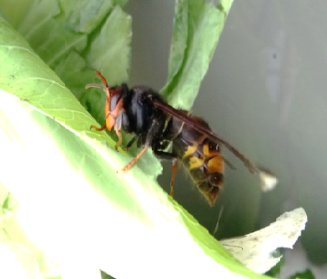
#3. Identify the insect in the photo
?
Photo courtesy The Animal and Plant Health Agency (APHA), Crown Copyright
#4. Select the answer which lists Asian Hornet, Wasp, and European Hornet in terms of size (Longest first)


#5. Where would you most likely find an Asian Hornet nest?
#6. What colour are the Asian Hornet’s legs?
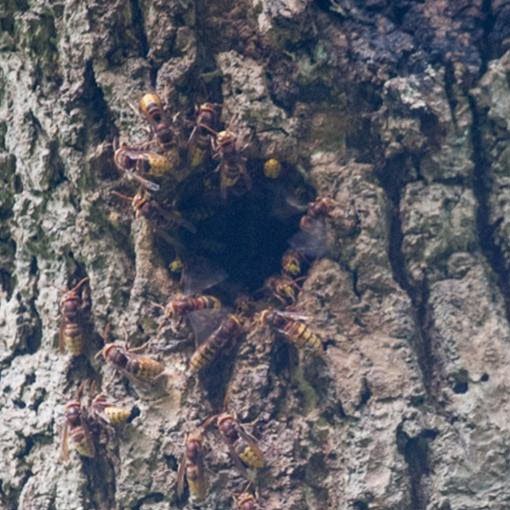
#7. Identify the insects entering this tree
#8. Which of these images is of an Asian Hornet?
#9. What is the preferred way to report a possible sighting?
#10. In addition to catching Asian Hornets, what is most important about the use of a monitoring trap?
You can find out more about Yellow Legged Asian Hornet HERE or on the National Bee Unit website.